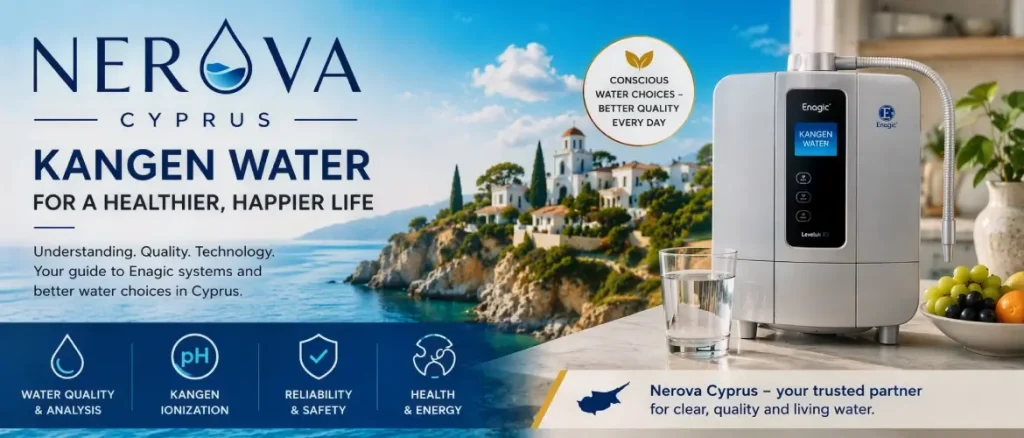
Kangen water Cyprus is usually searched by people comparing home water treatment options rather than looking for a general definition. In practical terms, the topic combines three questions: what Kangen water is, how the equipment produces it, and whether that process makes sense under Cyprus household conditions such as hard water, bottled-water dependence, and interest in reducing recurring water costs.
What Is Kangen Water and How Does It Work?
Kangen water is a brand-specific term for water produced by an ionization system installed on a kitchen tap. The machine first filters incoming water, then passes it across electrically charged plates in an electrolysis chamber. That process separates part of the flow into streams with different pH levels. The alkaline stream is typically used as drinking water, while other settings may produce more acidic water for non-drinking household tasks.
In everyday use, the important point is that Kangen water is not a separate source of water. Its quality still depends on the incoming supply. If the feed water contains excess scale-forming minerals, chlorine by-products, or other local issues, the machine can only work within the limits of its filter and electrolysis design. This is why a unit may perform differently from one property to another.
| Stage | What happens | Why it matters |
|---|---|---|
| Filtration | Removes selected impurities before ionization | Protects the system and improves input water quality |
| Electrolysis | Uses electric current and plates to separate water streams | Creates alkaline and acidic output options |
| Selection | User chooses a pH setting for intended use | Determines whether water is used for drinking or household tasks |
Kangen is primarily a system for modifying tap water at the point of use. It should be evaluated as a household treatment device, not as a universal replacement for testing local water quality.
Kangen water Cyprus: why local buyers are paying attention
Interest in Kangen water in Cyprus is tied to local water habits. Many households already spend regularly on bottled water, either because of taste concerns or because they do not fully trust tap water for daily drinking. A home ionization system enters that discussion as an alternative to repeated bottle purchases, not only as a wellness product.
Cyprus also has areas where hard water is a routine issue. Hardness does not automatically make water unsafe, but it affects taste, scaling, kettle performance, and appliance maintenance. Buyers looking at Kangen water Cyprus often want to know whether one device can improve drinking water quality while also reducing reliance on delivered packs or supermarket bottles. That practical motivation is stronger than brand curiosity alone.
Another factor is the local climate. Higher temperatures for much of the year increase daily water consumption. When a household drinks more water, differences in taste, convenience, and running cost become more noticeable. A system connected directly to the tap can be attractive for families that refill bottles throughout the day.
- Recurring spending on bottled water can add up over time.
- Tap water taste varies by area and building plumbing condition.
- Hard water encourages interest in treatment systems with multiple functions.
- Year-round warm weather increases the importance of easy access to drinking water.
At the same time, attention does not automatically mean suitability. Cyprus buyers usually need to check the local feed water profile, installation requirements, service availability, and plate or filter maintenance before assuming the system will deliver the same results seen in marketing material.
Potential Benefits of Kangen Water for Everyday Use
The main everyday appeal of Kangen water comes from convenience and user control. A household can produce treated water directly from the tap instead of storing multipacks, arranging deliveries, or replacing basic pitcher filters frequently. For people who drink a lot of water at home, that convenience can be the most tangible benefit.
Taste is another commonly cited reason for use. When the incoming water is acceptable for treatment and the filter is maintained correctly, some users find the drinking water more pleasant than untreated tap water. That can support better daily water intake simply because the water is easier to drink consistently. The benefit here is practical rather than theoretical: if a system helps a household move from low intake or heavy bottled-water dependence to regular tap-based drinking, it may improve routine hydration habits.
There can also be flexibility in household use. Depending on the machine and settings, users may choose different output types for drinking, rinsing produce, or certain cleaning tasks. This multi-use aspect matters more in homes that want one installed system rather than separate products for each need.
Limits are equally important. Kangen water is not a substitute for municipal compliance data, private water testing, or medical treatment. Claims about health outcomes should be reviewed carefully and separated from the more measurable advantages such as taste preference, direct access at the tap, and reduced bottled-water handling.
| Potential benefit | Practical meaning at home | Main limitation |
|---|---|---|
| Convenience | Water available on demand from the tap | Requires installation and regular maintenance |
| Taste improvement | May encourage more consistent drinking | Results depend on incoming water quality |
| Reduced bottle use | Less carrying, storage, and plastic waste | Upfront system cost is higher than simple filters |
| Multiple water settings | Supports several household uses | Not every setting is intended for drinking |
Hydration, taste, and daily drinking habits
For everyday drinking, the most practical question is not laboratory theory but whether people actually consume more water when it is readily available and pleasant to drink. Many users report that freshly ionized water tastes smoother than their regular tap supply, especially where tap water has a noticeable chlorine note or mineral sharpness. In practice, taste matters because it affects consistency. A household that keeps drinking water on demand at the kitchen sink often relies less on bottled water and may find it easier to maintain regular intake throughout the day.
That said, hydration still depends on total fluid consumption, not on a special mechanism unique to one brand of water. Kangen water can fit into a routine in simple ways: filling reusable bottles before leaving home, keeping a chilled jug in the refrigerator, or using it as the default table water at meals. The main benefit for many households is convenience combined with a taste profile they prefer. People who are sensitive to changes in water taste should also note that flavor can vary depending on the incoming tap water, filter condition, and selected setting on the unit.
A realistic expectation is improved drinking convenience and, for some households, better taste acceptance rather than a guaranteed change in hydration outcomes.
Cooking, tea, coffee, and food preparation
In the kitchen, users often judge Kangen water by how it performs in routine tasks rather than by technical specifications. For rice, soups, boiled vegetables, and stocks, filtered and ionized water may offer a cleaner starting point than untreated tap water, particularly if the local supply has a strong odor. Tea and coffee preparation is another common use. Water with fewer off-notes can make delicate teas taste less flat and may allow coffee flavor to come through with less interference from chlorine or other residual taste elements.
Results are not identical in every home. Hardness, mineral content, and the original water source still influence extraction and flavor. In some cases, users prefer one setting for drinking and another for cooking, while for espresso or specialty coffee they may compare results carefully because mineral balance affects brewing. For washing produce or mixing dough, the benefit is usually practical convenience: one filtered source for multiple kitchen tasks. The most useful approach is to test the water with foods and drinks you prepare regularly rather than assuming the same result across all recipes.
| Use | What users typically look for | Possible limitation |
|---|---|---|
| Tea | Cleaner taste, less tap-water odor | Flavor still depends on leaf quality and brewing method |
| Coffee | Reduced chlorine interference | Mineral balance can affect extraction |
| Cooking grains and soups | More neutral water base | Difference may be subtle with already mild tap water |
| Produce washing | Convenient filtered source at sink | Not a substitute for proper food hygiene |
Common Household Uses Beyond Drinking Water
Kangen systems are often discussed as drinking water devices, but many households use them for several daily tasks depending on the available settings. This is one of the main reasons some buyers compare them not only with standard filters but with broader kitchen utility equipment. Instead of maintaining separate water sources for drinking, light cleaning, and some food-related tasks, users may rely on one machine that produces water at different pH levels.
Typical non-drinking uses include rinsing vegetables, washing kitchen surfaces with the appropriate setting, and using selected water types for general household cleaning where a chemical-free rinse is preferred. Some owners also use specific outputs for skincare routines such as facial rinsing, although these uses are more personal and should be approached with realistic expectations. The practical advantage is not that every output replaces conventional cleaning products, but that it can reduce reliance on bottled specialty waters or separate countertop devices.
- Rinsing fruits and vegetables
- General kitchen prep and sink-side washing tasks
- Surface wiping with suitable water output
- Household routines that benefit from an on-demand filtered source
The value of these uses depends on how often the household will actually switch between settings. Buyers who only want better-tasting drinking water may not use the wider functionality enough to justify a premium system. Buyers who expect one unit to serve several routine tasks may see more practical benefit.
Acidic and strong acidic water applications at home
Acidic and strong acidic water outputs are commonly mentioned in relation to surface use rather than drinking. At home, they are typically used for tasks such as wiping counters, cleaning around sinks, and other light sanitation-oriented routines, depending on the machine model and setup. These applications should be understood as use-case specific. Effectiveness depends on correct production, storage time, and intended purpose, since some forms of acidic water lose potency over time.
It is also important to keep boundaries clear. Strong acidic water is not a universal replacement for all disinfectants, detergents, or regulated cleaning products. It should be used according to manufacturer guidance and with attention to material compatibility. For households considering these features, the practical questions are simple:
- Does the specific machine produce the required water type consistently?
- Will the household use these functions often enough to matter?
- Are there clear instructions for safe handling and maintenance?
Without those conditions, the extra outputs may sound useful on paper but deliver limited real value in day-to-day home use.
Kangen Water vs Bottled Water, Filters, and Other Options in Cyprus
For buyers in Cyprus, the practical comparison is not only about taste or pH. It is about source water quality, convenience, storage, recurring cost, and what each option actually changes. Kangen water is produced by an ionization unit connected to the household supply, so it depends on local tap water quality and on the machine’s filtration and electrolysis stages. That makes it different from bottled water, simple jug filters, under-sink carbon filters, reverse osmosis systems, and standard alkaline products sold in shops.
Bottled water offers consistency and avoids concerns about tap taste, but it adds repeated purchasing, transport, and storage. In Cyprus, that can be a noticeable issue in summer, in holiday homes, and for larger households. Standard filters usually focus on chlorine, sediment, and some odor or taste issues. They improve drinking water but do not usually produce different pH levels. Reverse osmosis can reduce a wider range of dissolved substances, though it also changes the mineral profile and often requires a storage tank and periodic servicing.
| Option | Main purpose | Typical strengths | Main limitations |
|---|---|---|---|
| Kangen system | Filtered and electrolyzed water | On-demand water, multiple water types, reduced bottle use | Higher upfront cost, depends on feed water quality, maintenance needed |
| Bottled water | Ready-to-drink packaged water | Convenient source, predictable taste | Ongoing cost, storage, plastic waste |
| Jug or basic carbon filter | Taste and odor improvement | Low entry cost, simple use | Limited treatment range, slow output |
| Under-sink filter | Improved tap water quality | Continuous supply, less clutter | No electrolysis, cartridge changes required |
| Reverse osmosis | Broad contaminant reduction | More intensive purification | Slower flow, wastewater, remineralization may be relevant |
The term alkaline often creates confusion in this comparison. Bottled alkaline water may provide a fixed pH but does not offer the same point-of-use flexibility as an ionizer. At the same time, a Kangen system is not a substitute for a full water treatment solution where the incoming water has specific quality problems such as excessive hardness, unusual contamination, or plumbing-related issues. In Cyprus, the best option often depends on whether the household’s priority is convenience, lower long-term dependence on bottled water, broader treatment, or simply better taste from the tap.
A useful buying standard is to compare systems by water source, filter specification, maintenance schedule, and real yearly cost rather than by pH claims alone.
How an alkaline water machine Cyprus buyers consider actually differs
An alkaline water machine is not just a filter with a different label. The main difference is that it combines filtration with electrolysis. After the incoming water passes through a filter, the machine uses electrically charged plates to separate the water into streams with different pH characteristics. One stream is used as drinking water, while other settings may produce water for different household purposes depending on the model.
For Cyprus buyers, the relevant distinctions are technical rather than promotional. Machines differ in electrode quality, number and surface area of plates, cleaning functions, flow rate, filter design, and the range of available pH settings. Some units offer only limited adjustment. Others provide several programmed levels for drinking water, cooking, and non-drinking applications. Build quality matters because the machine works continuously with mineral-containing water, and local hardness can affect scaling, maintenance frequency, and long-term reliability.
Another difference is installation context. A countertop machine may suit a rented apartment or a kitchen where permanent modification is not ideal. An under-counter machine is visually cleaner but usually needs more planning, more space, and professional installation. Buyers comparing one machine with another should look beyond marketing terms and check:
- Whether the unit is designed for the local water profile
- What contaminants the filter is rated to reduce
- How often the filter and internal components need service
- Whether replacement parts are available in Cyprus
- Whether the machine has automatic cleaning or descaling support
In short, the machine category differs from standard water filters because it changes more than taste. Within that category, however, not every alkaline water machine Cyprus households see on the market offers the same filtration quality, maintenance burden, or suitability for local tap conditions.
What to Check Before Buying a Kangen System in Cyprus
Before buying a Kangen system in Cyprus, the first check is the actual condition of the water entering the machine. Municipal supply can vary by area, and private sources or older buildings may add separate issues such as sediment, scale, or plumbing-related taste. A machine can only work properly within the limits of the incoming water. If the water has unusual hardness or quality concerns, pre-filtration or a different treatment setup may be necessary.
The second point is filter specification. Buyers should ask for the exact filter type, what substances it is designed to reduce, and how long the cartridge lasts under normal household use. A vague statement that the unit “purifies” water is not enough. What matters is measurable performance and whether that performance fits Cyprus household conditions.
Service access is equally important. A system with expensive proprietary parts or poor local support can become inconvenient after the initial purchase. Check whether the seller can provide installation, replacement filters, descaling guidance, warranty handling, and repairs locally rather than through long overseas delays.
Use requirements also matter. A small household with moderate drinking needs may evaluate the system differently from a large family using it for drinking, cooking, and frequent entertaining. Compare expected daily volume, available kitchen space, installation type, and ease of operation.
- Request a clear breakdown of upfront price, filter costs, and expected maintenance costs
- Confirm warranty length and what it actually covers
- Ask whether local water hardness affects performance or cleaning intervals
- Check installation needs, including adapters, drainage, and electrical access
- Verify availability of replacement consumables in Cyprus
- Ask for model-specific documentation rather than generic claims
A sensible purchase decision is based on local water compatibility, service support, and total ownership cost, not only on demonstrations or pH readings.
One more practical check concerns the seller’s explanation of non-drinking water settings. Buyers should know which outputs are intended for drinking and which are intended for cleaning or other household uses. Clear use guidance reduces misuse and gives a more realistic picture of what the system adds in everyday life.
Water quality, maintenance, and total ownership costs
Before buying, check whether the unit is suitable for the actual water supply in the property. Cyprus tap water can vary by area in hardness, chlorine level, dissolved minerals, and taste. These factors affect filter life, scale build-up, cleaning frequency, and overall performance. A machine that works well in one district may need more frequent servicing in another if the water is harder or carries more sediment.
Maintenance should be evaluated in practical terms, not only by the headline price of the system. Typical cost items include replacement filters, periodic deep-cleaning or descaling, possible service visits, and parts that wear over time. Ask for the expected filter lifespan in liters, not only in months, and request a maintenance schedule based on local water conditions. If the system has electronic cleaning functions, confirm what still needs to be done manually.
Total ownership cost usually depends less on electricity use and more on filters, servicing, and how well the machine matches the local water supply.
A useful buying check is whether the seller can explain running costs over three to five years with itemized estimates rather than broad claims.
Pricing, Value, and Long-Term Cost Considerations
Kangen systems are typically positioned as premium household water devices, so the main question is not only purchase price but cost structure over time. Buyers in Cyprus usually compare four expense layers: initial equipment price, installation or setup, recurring maintenance, and the cost offset versus bottled water or other filtration methods.
Value depends on actual use. In a household that drinks large amounts of bottled water and also uses filtered water for cooking, tea, and coffee, the economics can look different from a household that only wants occasional alkaline drinking water. A larger family may spread the fixed equipment cost across higher daily consumption, while a single user may find the payback period much longer.
| Cost factor | What to verify |
|---|---|
| Purchase price | Machine model, included accessories, warranty terms |
| Installation | Tap compatibility, any plumbing work, setup fees |
| Maintenance | Filter price, replacement intervals, cleaning needs |
| After-sales support | Local service availability, turnaround time, spare parts |
| Replacement savings | Reduction in bottled water purchases or separate filters |
Electricity use is usually a minor part of total cost. Filters and service matter more. The same applies to hidden costs such as early filter replacement in hard-water areas or delays in local support if a distributor cannot service the unit promptly.
Value should also be assessed against alternatives in Cyprus. A standard under-sink filter may cost less but does not provide the same range of water types. Bottled water avoids installation but creates ongoing purchase and storage costs. An alkaline water machine may make financial sense when the buyer expects regular daily use, understands maintenance requirements, and prefers an installed system over continuous bottled-water spending.
Who Kangen Water May Suit Best
Kangen water may suit households that want one installed system for daily drinking water and additional uses in the kitchen. It tends to be more relevant for buyers who are already spending regularly on bottled water, dislike carrying and storing water packs, or want more control over water output at home.
It may also suit users who place value on taste differences in tea, coffee, soups, and cooked foods, provided they understand that results depend on source water and the specific machine settings. Families with consistent water consumption often have a clearer use case than low-consumption households, because the fixed ownership costs are spread more efficiently.
This type of system is usually a better fit for buyers who are comfortable with scheduled maintenance and who prefer a long-term appliance purchase rather than a simple low-cost filter. It may be less suitable for people renting short term, households with very low water use, or buyers looking for the cheapest route to cleaner drinking water.
- Suitable for households replacing frequent bottled-water purchases
- Practical for families that cook at home and use treated water across several daily tasks
- More appropriate for owners than short-term tenants
- Less practical when budget sensitivity is the main factor
- Best for buyers willing to monitor filter replacement and servicing
In practical terms, the strongest fit is not based on marketing claims but on usage volume, local water quality, and willingness to maintain the equipment properly.
Questions to Ask a Seller or Distributor in Cyprus
A seller should be able to answer technical and operational questions clearly, with details that match Cyprus conditions rather than generic product descriptions. This helps separate a well-supported purchase from a costly one with unclear maintenance and service obligations.
- Is this model suitable for the water quality in my area of Cyprus?
- What pre-filtration, if any, is recommended for hard water or sediment?
- How long does the filter typically last in liters under local conditions?
- What maintenance does the owner do, and what requires professional service?
- How often is descaling needed, and what does it cost?
- What warranty is included, what is excluded, and who handles claims locally?
- Are spare parts and replacement filters stocked in Cyprus?
- What is the expected service response time if the machine stops working?
- What is the full price including installation, accessories, and setup?
- Can you provide an estimated three-year ownership cost based on my household size?
It is also reasonable to ask for a written breakdown of recurring costs and support terms. If a distributor avoids specifics on maintenance intervals, filter pricing, or local service capacity, that is a practical warning sign. Clear after-sales support matters as much as the machine itself.
Frequently Asked Questions About Kangen water Cyprus
This section addresses the practical questions that usually matter most at the final stage of comparison: local water compatibility, running costs, and whether an alkaline system makes financial sense in a Cyprus household. The answers depend less on marketing claims and more on feed water quality, filter replacement intervals, servicing access, and daily usage volume.
For Cyprus buyers, the main issue is not whether a system can produce alkaline water, but whether it can do so reliably with local tap conditions, acceptable maintenance, and realistic ongoing cost.
Is Kangen water suitable for Cyprus tap water?
In many cases, yes, but suitability depends on the specific supply in the property. Cyprus tap water can vary by area in hardness, mineral load, chlorine treatment, and overall taste. A Kangen system is designed to work with treated municipal water, yet performance can be affected when feed water is very hard or contains levels of scale-forming minerals that accelerate maintenance needs.
Before purchase, it is sensible to check a recent local water report or request a simple water test. Pay attention to hardness, chlorine, total dissolved solids, and whether pre-filtration is recommended. In harder-water areas, descaling frequency may be higher, and filter life may be shorter than expected under ideal conditions. If a seller cannot explain how the unit handles Cyprus tap water in your district, that is a useful warning sign.
Is an alkaline water machine Cyprus households buy expensive to run?
Running costs are usually moderate rather than extreme, but they are not negligible. The main recurring expenses are replacement filters, periodic cleaning or descaling, and any service visits required over time. Electricity use for a household water ionizer is generally low compared with major appliances, so it is rarely the biggest cost factor. The more relevant question is maintenance frequency under local Cyprus water conditions.
A practical way to estimate cost is to ask for an annual ownership breakdown, including:
- filter replacement schedule and price
- expected descaling frequency
- service call charges
- warranty coverage terms
- water wastage ratio, if applicable
For households replacing frequent bottled water purchases, the long-term cost may be easier to justify. For low-consumption households, the payback period is usually longer. An alkaline machine should be assessed as a multi-year appliance purchase, not as a low-cost kitchen accessory.
Final Buying Takeaways for Cyprus Consumers
The most sensible approach is to evaluate an alkaline machine on local practicality, not on broad claims. Cyprus buyers should confirm compatibility with their tap water, ask for clear maintenance expectations, and compare total ownership cost against bottled water or other filtration options. A unit that performs well in one area may require more frequent servicing in another due to hardness and scale.
| What to verify | Why it matters |
|---|---|
| Local water suitability | Affects performance, taste, and scaling frequency |
| Filter and service costs | Determines real long-term spending |
| Local support in Cyprus | Reduces downtime and uncertainty after purchase |
| Actual household usage | Shows whether the investment is proportionate |
For buyers seriously comparing options, the strongest decision criteria are transparent after-sales support, documented maintenance requirements, and a realistic fit with daily water consumption. That is usually more useful than focusing only on alkaline output figures or promotional language.